Guide
Inside the Dealership Machine: How Inventory, Floorplan, and F&I Actually Work
A clear-eyed tour of wholesale auctions, trade-in math, floorplan interest, aged-inventory policy, and the finance office — so you understand what really moves the metal.
By Motorscrape Team
From the curb, it is balloons and window stickers. Behind the wall, it is speed to market: metal financed by the day, buyers stalking wholesale lanes, and a closing desk that turns sheet metal into contracts. None of this makes every dealer adversarial—but it does explain why the process feels urgent, polished, and occasionally theatrical. Understand the machine, and you stop mistaking theater for truth.
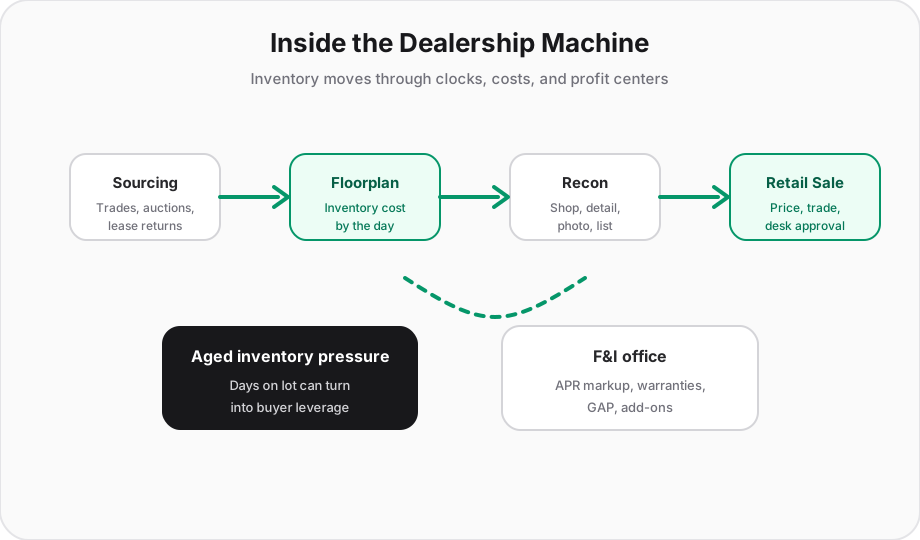
1. Buying and inventory sourcing
Walk-in trade-ins are only one inlet. Used-vehicle departments run parallel supply lines—each with different risk, margin, and paperwork.
- Dealer-only auctions. Private wholesale markets (platforms like Manheim or ACV Auctions are widely known examples) move program cars, rental fleet sell-downs, bank repossessions, and lease returns long before those VINs show up in your casual retail search. Auction bidding is fast and imperfect; a bad read on condition or recon cost does not stay abstract—it shows up in gross.
- Trade-in “appraisals.” Treat your trade as a sourcing event, not a courtesy. The desk stacks condition, mileage, retail demand, and expected reconditioning into a number that still leaves room for retail markup. That is why trade offers and private-party benchmarks diverge: both sides can be rational under different constraints.
- Lease returns and service-lane sourcing. High-volume stores sit next to customers before those cars surface nationally—lease-end dates, attractive models in the service lane, owners who just invested in major maintenance. Predictive tools and simple hustle share one goal: buy the right unit before it becomes a line item in a national sale lane.
2. The invisible carry: floorplan financing
Plenty of rooftops do not own every unit outright. Floorplan financing is a specialized line of credit secured by the vehicles themselves—inventory-shaped debt.
- Interest by the calendar day. Every day a car sits unsold, carry cost accrues. The lot is not passive storage; it is a clock.
- Turn as survival. Operators obsess over how fast stock converts to cash. You will hear turn-rate language in the trade; one often-cited aggressive benchmark is moving on the order of ~55% of inventory within about 30 days—not a law of physics, but a shorthand for “we cannot afford slow inventory.” Real targets vary by lender, brand, and store.
When you see a sharp price on a long-in-the-tooth unit, floorplan and aged-inventory pressure are often in the room—even if nobody says them out loud.
3. Inventory management and “aged” units
Modern retail runs on dealer management systems (DMS) and satellite tools that track stock, velocity, recon status, wholesale channels, and transfers across sister rooftops.
- Reconditioning is a sprint. Mechanical and cosmetic recon has to clear the shop quickly; every bay day is a day the vehicle is not retail-ready.
- Aged-vehicle policy. Many stores enforce a non-negotiable clock—often 60 or 90 days without a retail sale. Then the playbook flips: flush pricing, send the unit back to auction, or swap it to a store in the group where that model might turn faster.
When days-on-lot is visible in your research, you are reading the same urgency the desk sees—only from the buyer’s edge of the desk.
4. Selling and the F&I office
Sticker agreement is often just the ante. Finance and insurance (F&I) is where backend profit and long-term cost stack.
- Menu selling. F&I managers run structured menus—extended service plans, GAP, tire-and-wheel, appearance bundles—often packaged as a calm, opt-down experience instead of a single yes/no ambush.
- Loan markup (rate participation). A lender may approve a wholesale or “buy” rate; the store may present a higher retail rate and keep the spread where law and program rules allow. Your counterweight is boring and effective: independent pre-approval, APR comparison, and insistence on out-the-door math before monthly payment becomes the only number in the room.
- Structuring the first pencil. Early payment options may lean on 72- or 84-month terms so the monthly line looks tame while total interest swells. Longer terms are not automatically wrong—they are just a common place to hide a weak vehicle price.
How this helps you as a buyer
You do not have to beat a wholesale buyer at their own auction—you need to anchor on market reality: comparable listings, vehicle history where you can get it, and time-on-lot signals that explain dealer motivation. Motorscrape's live search is built to put local competition and days-on-lot context next to the rest of these guides on timing and negotiation. Let the store’s economics inform your patience, not replace your homework—and you walk in sharper, quieter, and harder to rush.