Guide
The Sarcastic Guide to Buying a Car: How to Lose Money and Alienate Dealerships
Tired of having too much money? Follow this foolproof, highly sarcastic guide to ensure you pay the absolute maximum for your next vehicle while suffering maximum emotional damage.
By Motorscrape Team
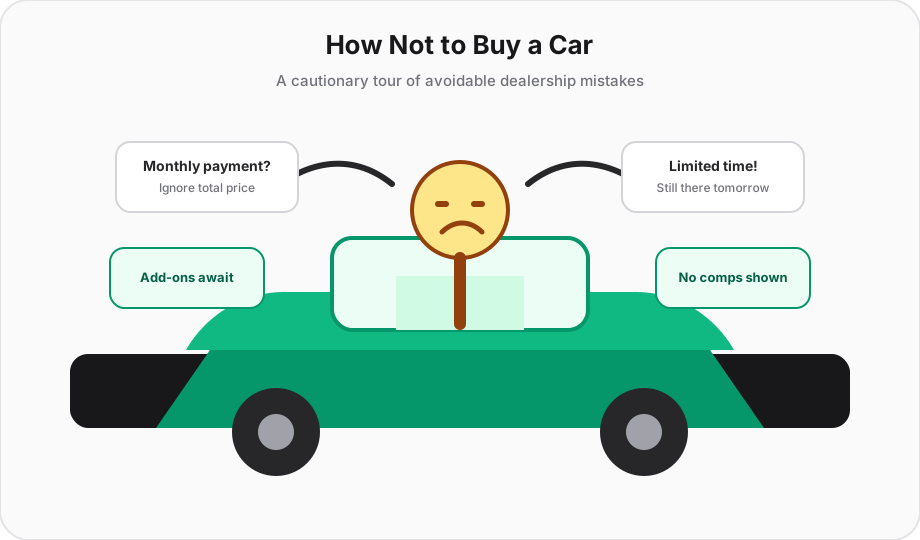
Welcome to the ultimate guide for the modern automotive consumer. Are you burdened by an excessively heavy wallet? Does the thought of a reasonable monthly budget fill you with existential dread? Do you wake up in cold sweats, terrified that you might accidentally make a sound financial decision?
Fear not. You have come to the right place.
Buying a car doesn't have to be a calculated, data-driven process where you leverage market medians and negotiate from a position of strength. Where is the romance in that? Where is the adrenaline rush of signing away your future children's college fund for a mid-size crossover that will be worth half its value by the time you reach the nearest drive-thru?
If you want to ensure you pay the absolute maximum for your next vehicle while suffering maximum emotional damage, simply follow this foolproof, step-by-step guide.
Step 1: Do Absolutely Zero Research
The first rule of overpaying for a car is to maintain a state of blissful, impenetrable ignorance. If you look up invoice prices, market medians, or days-on-lot statistics, you risk accidentally forming a realistic expectation of what a car is worth. This is dangerous.
Instead, rely entirely on the manufacturer's television commercials. If the commercial shows a ruggedly handsome lumberjack driving a pristine pickup truck up a vertical mountain face to rescue a stranded eagle, assume that the base model with cloth seats and a four-cylinder engine can do exactly that.
Do not use tools like Motorscrape. Data is the enemy of a truly spontaneous, financially ruinous purchase. If you know that the dealership down the street has the exact same car for $4,000 less because it's been sitting on their lot for 90 days, you might be tempted to go there. Resist this urge. Ignorance isn't just bliss; it's the foundation of a truly spectacular 84-month loan.
Step 2: Fall in Love at First Sight
When you arrive at the dealership, it is crucial that you immediately form a deep, irrational emotional attachment to the first shiny object you see. Walk right past the practical, reliable sedans and head straight for the bright red sports coupe with the carbon fiber trim package that costs more than your first house.
When the salesperson approaches, do not play it cool. Let your jaw drop. Wipe a tear from your eye. Whisper, "It's exactly what I've always dreamed of," loud enough for the sales manager in the glass tower to hear you.
By telegraphing your absolute desperation to own this specific vehicle, you completely eliminate any negotiating leverage you might have accidentally brought with you. The dealership now knows that you are not a rational actor making a transportation decision; you are a lovestruck romantic who will sign anything to take their new baby home.
Step 3: Announce Your Maximum Monthly Payment Immediately
As soon as you sit down at the salesperson's desk, before they even ask, proudly declare the maximum amount you can possibly afford to pay each month. Say something like, "Look, I'm a straight shooter. I can't go a penny over $850 a month."
Congratulations! You have just given the dealership the only number they care about. They will now magically construct a deal that hits exactly $849.99 per month.
How will they do this? By extending the loan term to 96 months. By rolling in $5,000 of negative equity from your trade-in. By adding a $3,000 "market adjustment" fee and a $1,500 "nitrogen tire fill and pinstripe" package. You won't notice any of this, of course, because you'll be too busy celebrating your incredible negotiating skills. After all, you came in under budget by a whole penny!
Step 4: Accept All Dealer Add-Ons Without Question
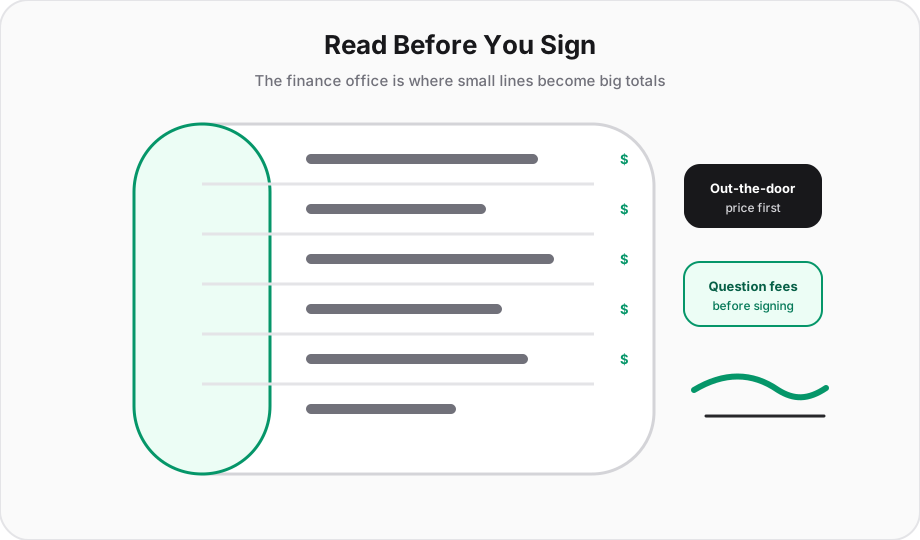
At some point, you will be introduced to the Finance and Insurance (F&I) manager. This person is not there to help you finance or insure your car; they are there to sell you things you didn't know existed and definitely don't need.
When they offer you the "Platinum Shield Paint Protection System" for $2,500, do not ask what it is. (Spoiler: It's wax. They are charging you $2,500 for a teenager to wipe wax on your car.) Just nod solemnly and say, "Yes, I must protect my investment."
When they offer the "Fabric Defense Matrix" for $1,200, agree immediately. You never know when you might spill a highly corrosive acid on your seats, and it's better to be safe than sorry.
VIN etching? Yes. Wheel locks? Absolutely. The "Premium Dealership Experience Fee"? It sounds fancy, so you definitely want it. By the time you leave the F&I office, your $30,000 car should cost at least $42,000. If it doesn't, you aren't trying hard enough.
Step 5: Trade In Your Old Car for Pennies on the Dollar
Trading in your old car is a fantastic opportunity to lose even more money. To maximize your losses, do not clean your car before bringing it to the dealership. Leave the fast-food wrappers in the back seat. Let the dog hair accumulate. Make sure the check engine light is on.
When the dealer offers you $4,000 for a car that Kelly Blue Book says is worth $10,000, do not argue. Accept their explanation that the market for your specific shade of beige has "really softened lately."
Do not, under any circumstances, get a competing offer from CarMax or Carvana. And definitely do not try to sell it privately. That would require effort, and as we've established, you are here to hemorrhage cash as efficiently as possible.
Step 6: Finance Through the Dealership at the Highest Possible Rate
Before you go car shopping, you might be tempted to check with your local credit union to get pre-approved for a loan at a reasonable interest rate. Stop right there. That is a terrible idea.
If you walk in with your own financing, the dealership can't mark up the interest rate and make a profit on the loan. That's just selfish on your part. Instead, let the dealership handle everything.
When they tell you that you qualify for a 12% interest rate (despite your 780 credit score), thank them profusely. Remember, the higher the interest rate, the more you get to pay over the life of the loan! It's like a high score in a video game, but with real money.
Step 7: Ignore the Out-the-Door Price
Throughout this entire process, the dealership will present you with a confusing array of numbers: the MSRP, the invoice price, the trade-in allowance, the down payment, the monthly payment, and the interest rate.
There is only one number that actually matters: the Out-the-Door (OTD) price. This is the total amount you are paying for the vehicle, including all taxes, fees, and add-ons.
Therefore, you must ignore the OTD price completely. Focus entirely on the monthly payment and the shiny new keys sitting on the desk. If you look at the OTD price, you might realize that you are paying $55,000 for a car that is worth $35,000, and that might ruin the magic of the moment.
Step 8: Bring Your Entire Family (Including the Dog)
If you really want to ensure you make a terrible, hasty decision, bring as many distractions as possible. A spouse who just wants to go home, three toddlers who have consumed their body weight in dealership lobby hot chocolate, and a golden retriever that is currently shedding on a display model.
The sheer sensory overload will completely short-circuit your prefrontal cortex. When the salesperson asks if you want the extended warranty, you won't have the mental bandwidth to calculate the cost-benefit ratio. You will just say "yes" because you want the noise to stop. You will sign anything just to get your family out of that glass-walled interrogation room.
Step 9: The "I'm in a Rush" Strategy
Nothing signals to a dealership that you are ready to be taken advantage of quite like checking your watch every five minutes and announcing, "I really need to wrap this up, I have a tee time in an hour."
When you are in a rush, you don't read the contract. You don't question the fees. You don't notice that the interest rate somehow jumped from 6% to 9% while you were in the bathroom. You just sign where the yellow sticky notes tell you to sign.
Dealerships love a buyer in a hurry. It's the automotive equivalent of shooting fish in a barrel, if the fish were also handing you their wallets.
Step 10: Believe Everything the Salesperson Says About Reliability
When you ask if the obscure, discontinued European luxury sedan you are looking at is reliable, and the salesperson says, "Oh absolutely, these things run forever," you must accept this as gospel truth.
Do not look up consumer reports. Do not read forum posts from owners who have had to replace the transmission three times before 50,000 miles. The salesperson is wearing a tie; therefore, they are an unimpeachable authority on mechanical engineering.
When the car inevitably breaks down three days after the warranty expires, you can comfort yourself with the knowledge that you were a very polite and trusting customer.
Step 11: Never Walk Away
The most powerful negotiating tool a buyer has is the willingness to walk away. If you don't like the deal, you can simply stand up, thank them for their time, and leave.
But walking away means you don't get a new car today. And you want a new car today. You *need* a new car today.
So, no matter how insulting the offer is, no matter how many hidden fees they try to sneak into the contract, no matter how many times the salesperson has to "go talk to their manager," you must stay planted in that uncomfortable chair.
If you feel the urge to leave, just look out the window at that bright red sports coupe. Think about how cool you'll look driving it. Think about how jealous your neighbors will be. Then, pick up the pen and sign on the dotted line.
Conclusion: The Joy of Financial Ruin
Congratulations! If you have followed these steps carefully, you are now the proud owner of a depreciating asset that you will be paying off until the next ice age.
You have successfully avoided using data, logic, or basic common sense. You have bypassed tools like Motorscrape that could have saved you thousands of dollars by showing you market medians and days-on-lot statistics. You have embraced the chaos and surrendered your wallet to the automotive gods.
As you drive off the lot, ignore the sudden, sinking feeling in the pit of your stomach. That's just the sound of your net worth plummeting. Turn up the radio, roll down the windows, and enjoy the ride. After all, you've earned it.
And hey, when you're finally ready to trade this one in (while still owing $15,000 more than it's worth), the dealership will be waiting for you with open arms. They love a repeat customer.