Guide
7 Proven Strategies to Cut Your Lifetime Car Ownership Costs by 35–55%
Most owners spend $80,000–$120,000 on vehicles over 15 years. This advanced guide reveals data-backed tactics — from purchase timing to maintenance discipline to resale optimization — that can literally save you a new car’s worth of money over a decade.
By Motorscrape Team
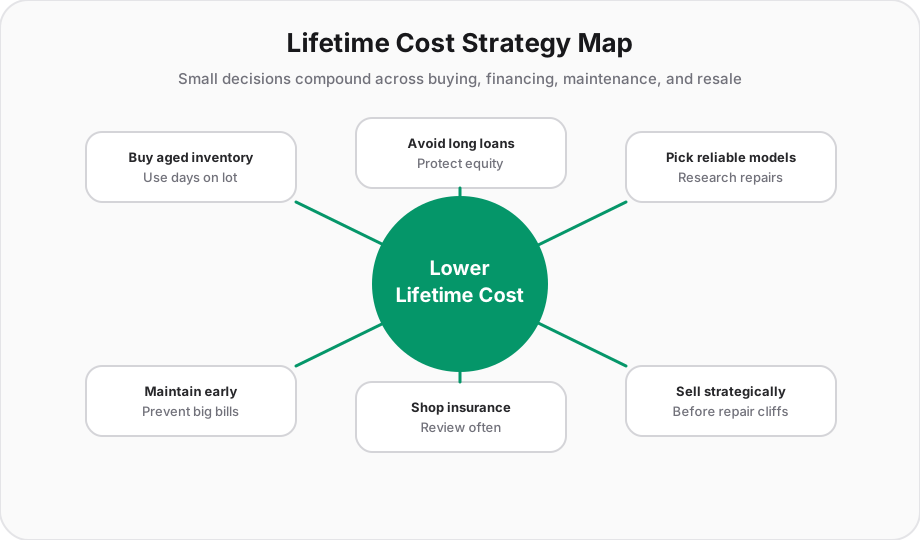
While the previous guide quantified *what* car ownership actually costs, this advanced strategic playbook reveals exactly *how* to systematically slash those costs by 35–55% through deliberate, repeatable decisions at every stage of the ownership lifecycle.
Strategy 1: Master the Purchase Decision (Biggest Single Lever — ~40% of Total Savings)
The price you pay sets the foundation for depreciation, insurance premiums, and financing costs.
High-Impact Tactics:
- Days-on-Lot Targeting: Use Motorscrape to filter for vehicles with 60–120 days on the lot. Floor plan interest ($40–$90/day in 2026) makes dealers extremely motivated. Discounts of 12–22% off asking price are common.
- Triple Pressure Timing: Buy at the convergence of (1) model-year changeover, (2) month/quarter-end quota pressure, and (3) high days-on-lot. This combination frequently produces 20–28% off original MSRP.
- CPO Sweet Spot: Certified Pre-Owned luxury vehicles in the 18–30 month range often represent the single best value in the market — near-new condition with extended warranty at 52–68% of new price.
Illustrative scenario (hypothetical, not a real transaction): Imagine a late-model SUV with roughly 90 days on lot during a quota-heavy month. Negotiating from data-backed competing quotes—not from emotion alone—could move the out-the-door price thousands below the initial ask. Actual discounts depend on trim, lender rules, trade-in, taxes, and dealer willingness; always verify with written quotes in your market.
Strategy 2: Optimize or Eliminate Financing ($8,000–$18,000 lifetime savings)
- Minimum 25% down payment on any financed vehicle.
- Never exceed 60-month terms. The interest savings alone usually exceed $6,000.
- Credit union or online lender pre-approval almost always beats dealer financing by 1.5–3.2 percentage points.
- Pay cash for vehicles under $28,000 whenever possible — the psychological and mathematical benefits are massive.
Strategy 3: Choose Vehicles with Proven Low Lifetime Costs
Data-driven selection is critical. 2026 reliability and cost rankings show clear winners:
Top Tier (Lowest TCO):
- Toyota Camry, Corolla, and RAV4 Hybrid
- Honda Accord, Civic, and CR-V
- Mazda3 and CX-5 (surprisingly excellent long-term value)
Avoid or Approach Cautiously:
- Most German luxury brands after year 5 (maintenance costs can triple)
- Certain domestic full-size trucks with complex electronic systems
- Vehicles with known hybrid battery or transmission issues in that generation
Motorscrape lets you overlay reliability data with live local inventory so you can see which low-TCO models are actually available near you with motivated pricing.
Strategy 4: Implement Ruthless Maintenance Discipline
- Follow "severe service" intervals if you drive in stop-and-go traffic or extreme weather.
- Change oil every 5,000 miles instead of 8–10k.
- Use independent specialists after warranty instead of dealership service departments (35–50% savings).
- Address small problems immediately — preventive maintenance is almost always cheaper than reactive repairs.
Maintenance Calendar Template (save this):
- Every 5k miles: Oil + filter + inspection
- Every 30k miles: Major service (brakes, fluids, alignment)
- Every 60k miles: Transmission service, spark plugs, coolant
- Every 90–100k miles: Major timing components and suspension refresh
Strategy 5: Master Strategic Selling Windows
Sell at the optimal point on the depreciation and repair curves:
- Ideal window: 45,000–70,000 miles while still under extended warranty
- Avoid selling right before or after major scheduled services (buyers discount heavily)
- Use Motorscrape price history to time your sale when local market values are peaking
Many owners lose $4,000–$8,000 by holding vehicles into the $3,000–$6,000 repair years.
Strategy 6: Continuous Insurance Optimization
- Raise deductibles to $1,000+ once vehicle value drops below $18,000
- Bundle policies and take every available discount (defensive driving, low mileage, garaging)
- Shop rates every 18 months — loyalty penalties are real
- Consider usage-based insurance programs if you drive under 10k miles/year
Strategy 7: Adopt the "One High-Quality Car" Mindset
The absolute lowest per-mile cost structure is usually one excellent, reliable vehicle driven more miles rather than two mediocre cars.
Math Example: One $34,000 well-chosen vehicle driven 17k miles/year often has a lower total cost than two $19,000 vehicles each driven 8.5k miles/year due to economies of scale on insurance, registration, and maintenance.
The Compounding Effect Over 15 Years
Implementing 4–5 of these strategies typically reduces lifetime vehicle spending from ~$115,000 to $52,000–$68,000 — enough to fund a substantial retirement contribution or home improvement.
Motorscrape was built specifically to supercharge strategies 1, 3, and 5. The live inventory pressure signals, price trend graphs, and multi-dealer comparison tools give you an unfair advantage that traditional car buyers simply do not have.
Start tracking motivated inventory in your area today. The difference between average ownership costs and optimized ownership costs is literally life-changing money over a 15–20 year driving career.